Showing posts with label travel. Show all posts

Friday, 28 May 2010

Moving Up

It all started with a missed bus. After some two weeks of deliberating, on February 28 2009,  me and Priyo were finally out at the Anand Vihar ISBT, hoping to get one of the frequent- so we were told- buses to Almora. So we arrive bright and chirpy at 6 in the morning only to find that the bus had left at 5:45- and that there would be no other bus till the evening. While we were casting about at this unfortunate turn of events, the conductor of the Delhi-Nainital bus threw us a lifeline. Why not take the Nainital bus to Haldwani, and then take a bus to Almora in the afternoon? As the Nainital bus was just about to leave, we quickly boarded without any further invitation.
                                           
Pic: Priyo, my travelling companion (Bibek Bhattacharya)

Delhi to Haldwani, some 120 km, is a dead bore of a drive as the majority of that distance involves travelling through northern UP, which is nobody's idea of a beautiful place. 
Well, in between the horrid towns there is enough to see- like lush green fields of winter crops waiting to be harvested- but mostly your senses are overburdened with massive political posters of all hue and ideology asking for your precious vote.

                                        
Pic: The sprawl of Moradabad is symptomatic of northern UP in general (courtesy Wikipedia)

Its interesting to see the scenery change gradually. The flat green lands of the Gangetic plain gradually change into the upper Terai forests once you cross the border into Uttarakhand. I must say though, that 'developement' makes the Gangetic plain pretty difficult to spot. When we did cross the Ganga over an ancient rickety bridge chock-a-block full of traffic, all I could think of was murder as all I could see was hideous over-construction choking the river. A few hours of somnambulist travel through the dust choked landscape the bus arrived at Moradabad. It got intensely crowded in Moradabad, almost like a cliche of people jostling with chicken, and for a while it turned into a inter-city public transport.
Things started getting interesting after we crossed over into Uttarakhand at Rampur. Between Rampur and Haldwani, lies a long stretch of beautiful forests. This is a common enough feature throughout the Terai region, which stretches all the way from Himachal Pradesh, across Nepal and upper West Bengal and Sikkim

                                     
Pic: The Terai valley near Rishikesh (Bibek Bhattacharya)

Just before the Himalayan foothills begin, you're bound to pass through an upper Terai jungle of some shape or size. The entire length is criss-crossed by a number of Himalayan rivers passing through to join the two main ones, Ganga and Yamuna. Sadly, this beautiful catchment area of the subcontinent is disappearing under the combined weight of human habitat and industry. 
Soon it was around two in the afternoon and I was getting antsy as there didn't seem to be any sign of a hillock, let alone mountains. Then suddenly, hey presto, green, rolling foothills looming gently on the horizon! We were finally at Haldwani.

                                    
Pic: Haldwani (Bibek Bhattacharya)

Haldwani is one of those entry-points into the mountains, like Dehradun and Rishikesh in the west, and Siliguri in the east, which are major transport hubs, as roads fan out from these places to other towns deeper in the hills. 
Priyo happily lit a biri to celebrate our successful journey to the half-way point while I went to the ticket counter to find a bus to Almora. Here the helpful Nainital conductor turned out to be a pretty clueless bloke. He insisted that Binsar is closer from Ranikhet than from Almora, and that we should try for a bus to Ranikhet instead. I consulted  my handy Eicher road map (as well as the Nest & Wings state map) and found this claim impossible to believe. In this we were proved quite right. Everyone we asked at the bus stop was unanimous that Binsar is near Almora. It was only later that I found out that there is indeed another Binsar near Ranikhet, called Binsar Mahadev, but by no stretch is it the Binsar.
Tragedy threatened for the second time in the day when we were informed by an apologetic man in the Enquiry booth that the sole bus for Almora from Haldwani had left at 2:30 pm, and here we were, standing in the middle of a chaotic bus depot at 3 pm, wondering what to do. What we didn't know at the time was that the man was referring to just State Transport buses.
Some stray voices in the seething chaos helpfully informed us that the Delhi-Almora bus that we had missed in the morning had gotten delayed and had yet to reach Haldwani. So we rushed to the main road waiting for the  mythic bus to appear, hoping against hope that we hadn't missed it a second time. We were desperate to keep moving, reach at least Almora by the end of day. A cry went up and  sure enough, there it was, disgorging passengers. Feeling quite happy with ourselves, we parked our relieved haunches on it and breathed a sigh of relief.
Apart from the local Kumaonis, very few people actually travel the full distance from Delhi to Almora or from Delhi to Nainital by the morning bus. This suited us just fine, as the this one was just about half full with local families travelling between towns.
Beyond Kathgodam- this is as far as the train line gets in the Kumaon- the road started climbing up the foot hills and I started grinning stupidly even as my spine started tingling with anticipation. My mind was screaming "ALTITUDE!" in big capital letters. The next couple of hours passed in a blur, with me hanging out of the bus window taking pictures, or just looking at the gorgeous views. Even the humblest of shacks in the Himalaya are transformed by the majestic backdrop. There were some 20 different places along the way which I thought would be perfect for my fantasy house in the hills. A happy dream.


Pic: Winding up the road to Almora (Bibek Bhattacharya)

Winding up the deep, labyrinthine gorge of the Kosi, we finally started climbing the Almora ridge around 6, exactly 12 hours since we'd set out. The sun was setting behind some high ridges across the valley, and a dramatic sickle moon was starting its progress across the heavens. By the time the bus stopped at the Almora bus depot, it was already dark and we were debating whether to stay the night in Almora or try and get into Binsar. Priyo and I were both of the view that we should end the epic journey in Binsar itself, rather than waste the night at Almora. After fighting off a bunch of well-intentioned cab drivers, we got into the car of one Ramesh, who agreed to take us up for Rs 700, the standard rate. 

Thursday, 27 May 2010

A Remarkable Man

Here's something I came across on Project Gutenberg. This is a book published in 1899 by the English adventurer/painter/traveller/raconteur called Arnold Henry Savage Landor- an account of his somewhat alarming, but extremely interesting travels and travails in Southern Tibet in 1897 called In the Forbidden Land.


Pic: The Tibetan weather and Landor's hardships leave their mark (early 1897 and late 1897)
Taking place shortly after Francis Younghusband's legendary overland spying trip and preceding the Younghusband-led invasion of Tibet, this is a fascinating account. Two things I'd like to share here, the first one a painting of the classic lower Eastern Kumaon view of the Himalayan crest, with the famous contours of Nanda Devi, Trishul and Nanda Kot rearing up like a feverish dream. The funny thing is, the peaks really do look like this in real life.

Pic: Landor's painting of the Kumaoni peaks of Nanda Ghunti, Trishul, Nanda Devi and Nanda Kot 
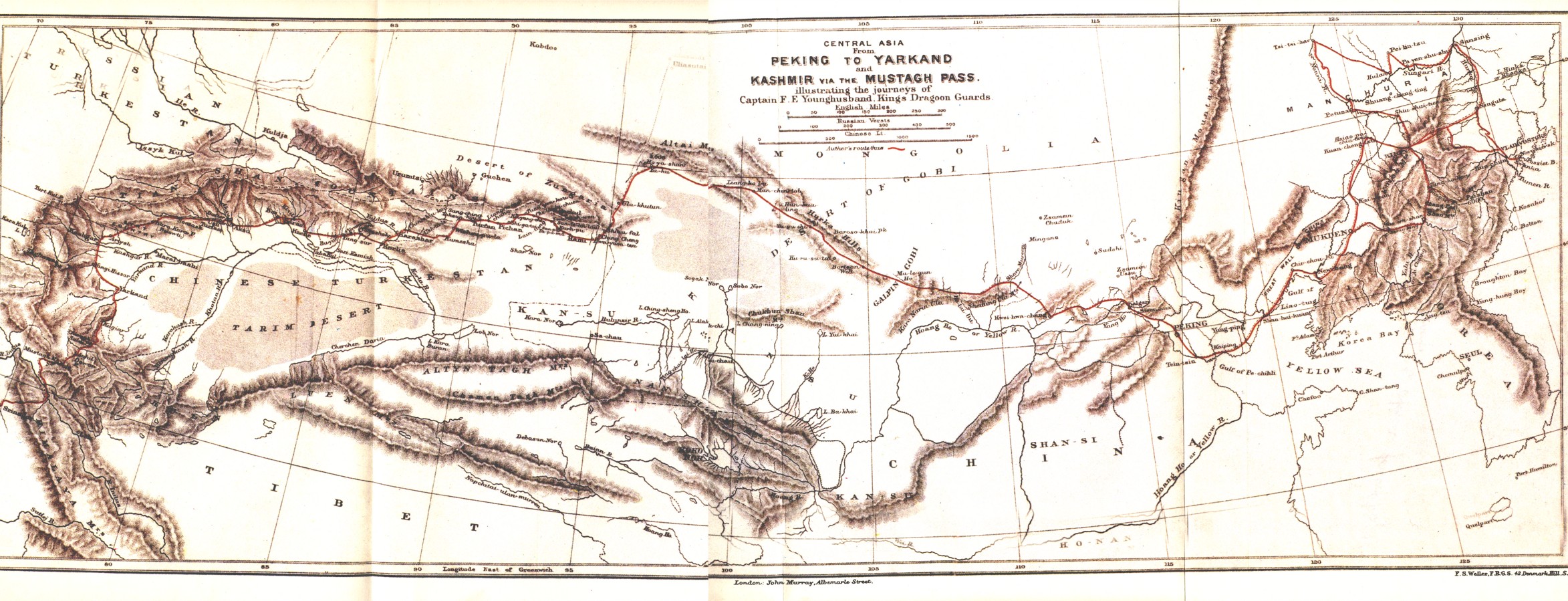
The second thing is the author's map of his travels, which is fascinating in the number of Indo-Tibetan passes it maps, as well as routes and natural features stretching parallel to the Tibetan-Nepalese border all the way to Everest.


Pic: Landor's map of his travels in Southern Tibet
He was working under the aegis of the Royal Geographical Society- definitely as a surveyor, maybe as a spy- and made many important discoveries on this trip, which included finding the sources of the Indus and the Tsang Po (Bramhaputra) rivers.

In approaching Tibet, Landor takes the traditional trading and pilgrim route to Tibet from Kumaon, which lies along the Kali river- it forms the natural boundary between India and Nepal- following the route from Nainital, via Almora and Pithoragarh to Garbyang on the Indo-Tibetan border, which is crossed via the high Lipu-Lekh Pass.

Pic: Two views of Lipu-Lekh pass; (above) the southern face, India and (below) the northern face, Tibet
Near here the Kali river forms a fearsome, rain-lashed and dark gorge, which is at its worst beyond the village of Nirpani. I'd first read about it in Umaprasad Mukherjee's 1934 account of his trek to Kailash-Mansarovar. His description of the gorge is hair raising and it feels great to come across Landor's photographs and paintings of this fearsome place.


Pic: Landor's photograph and painting of the fearsome Kali river gorge at Nirpani
Then there is a striking painting of Taklakot, the first fortified village on the Tibetan side of the pass, where the local Tibetan border and tax officials resided.

Pic: Landor's painting of Taklakot fort in Tibet
There's plenty more, including two very atmospheric renditions of of the twin holy lakes of Hindus and Tibetans- Rakhshas Tal (Langa Tso) and Mansarovar (Mapham Yutso). In the background of the Rakhshas Tal painting, you can see the Holy of Holies Mt Kailash (Gang Rinpoche) rising like a mystical lightning rod.

Pic: Mansarovar lake (above) and Rakhshas Tal with Mt Kailash in the background (below)
Landor was a fascinating man. Grandson of a British poet settled in Florence, he painted world leaders- from US President Benjamin Harrison to Czar Nicholas- and regularly hobnobbed with many more, including Queen Victoria and Franklin Roosevelt.

In the main, he was an inveterate traveller from 1889 to 1915, exploring the remaining blank frontiers of Western knowledge in Tibet, Japan, China, Nepal, Abyssinia, Philippines, Persia and the Amazon river- painting and writing lively travelogues. What's more, he did the overland route from Holland to Calcutta through Persia with a posse of cats. One of them suffocated in the heat of a train carriage in India, and he never quite forgave the country for it.

Pic: Landor with his cats Kerman and Zeris who accompanied him on his overland Persian trip
Almost certainly an agent of Empire in the Great Game, he was a success both on the trail and on the printed page, his best-selling books getting him lucrative lecture tours all over the world, and further travel opportunities, which suited this raconteur just fine. He seems to me that quintessential roving Englishman of the Empire, a witness to history.


IndiBlogger - The Indian Blogger Community

Monday, 24 May 2010

Map Woes Part 4

(...continued from Map Woes Part 3)

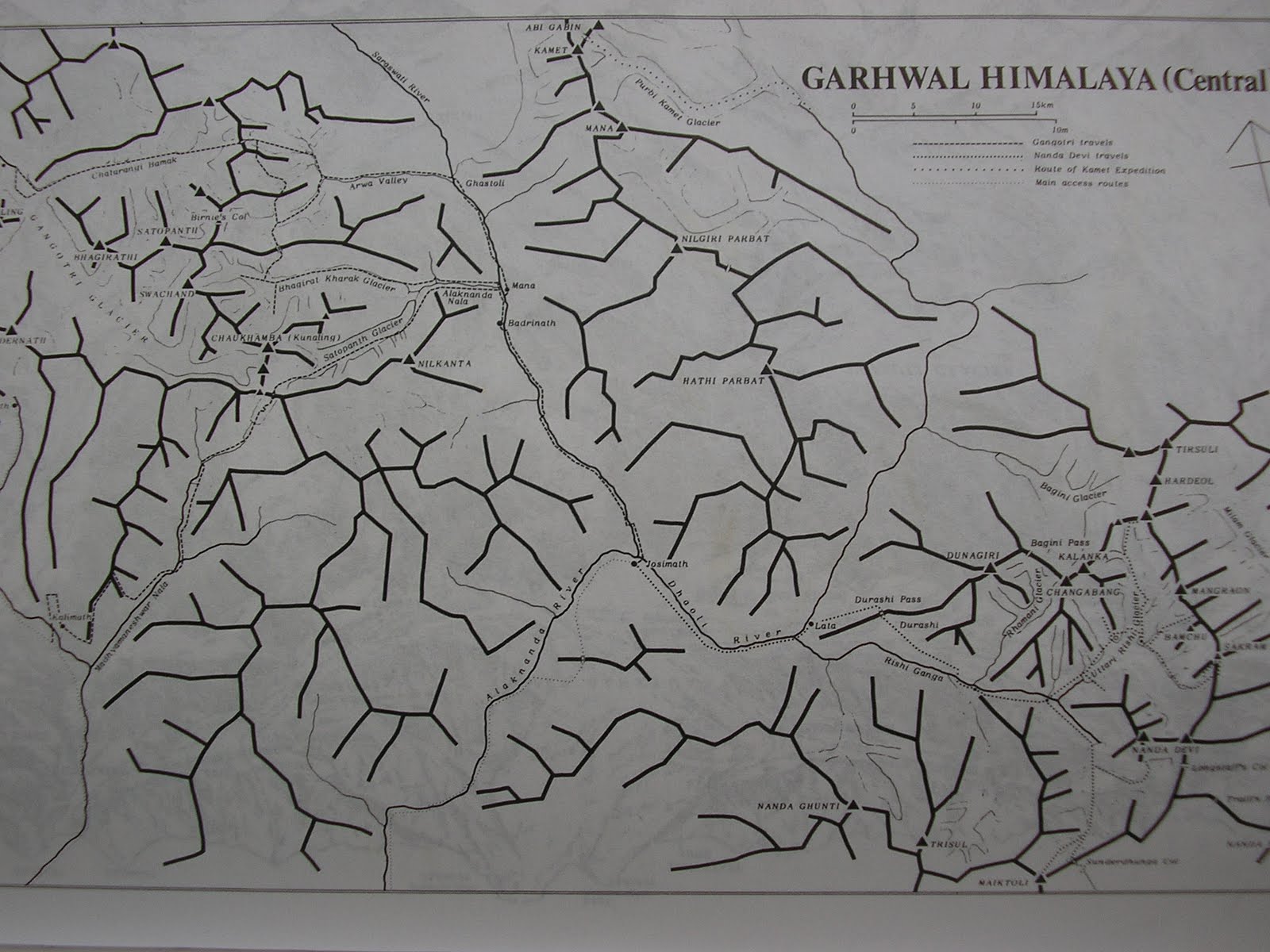
A recent visit to the Survey of India map sales office in Delhi was most frustrating. The people there were extremely reluctant to show me any maps without me first telling them the exact sheet number- they probably even need the latitude and longitude- and even then could only give me some large but pretty useless trekking maps of the Gangotri, Badrinath, and Shimla hills regions.

Pic: The impressive looking but ultimately disappointing trekking map from SOI (Bibek Bhattacharya)

They were careworn and mothballed, and the contour maps were kept firmly out of sight. I had made the mistake of going there without the sheet names and they effectively used it against me. And of course there’s that eternal suspicion. Just who is this person, they think. Why does he want topographical maps of border areas?

I had to settle for the trekking maps. Next time I go, I’ll take a sheet of paper with ALL the sheet names I can think of, and then some. And this time, if they demur, I will HAVE to do the unethical thing and wave my press card at them!

But then, a few weeks ago, I found this! I’d heard of it before, but I had no clue that it was freely available.

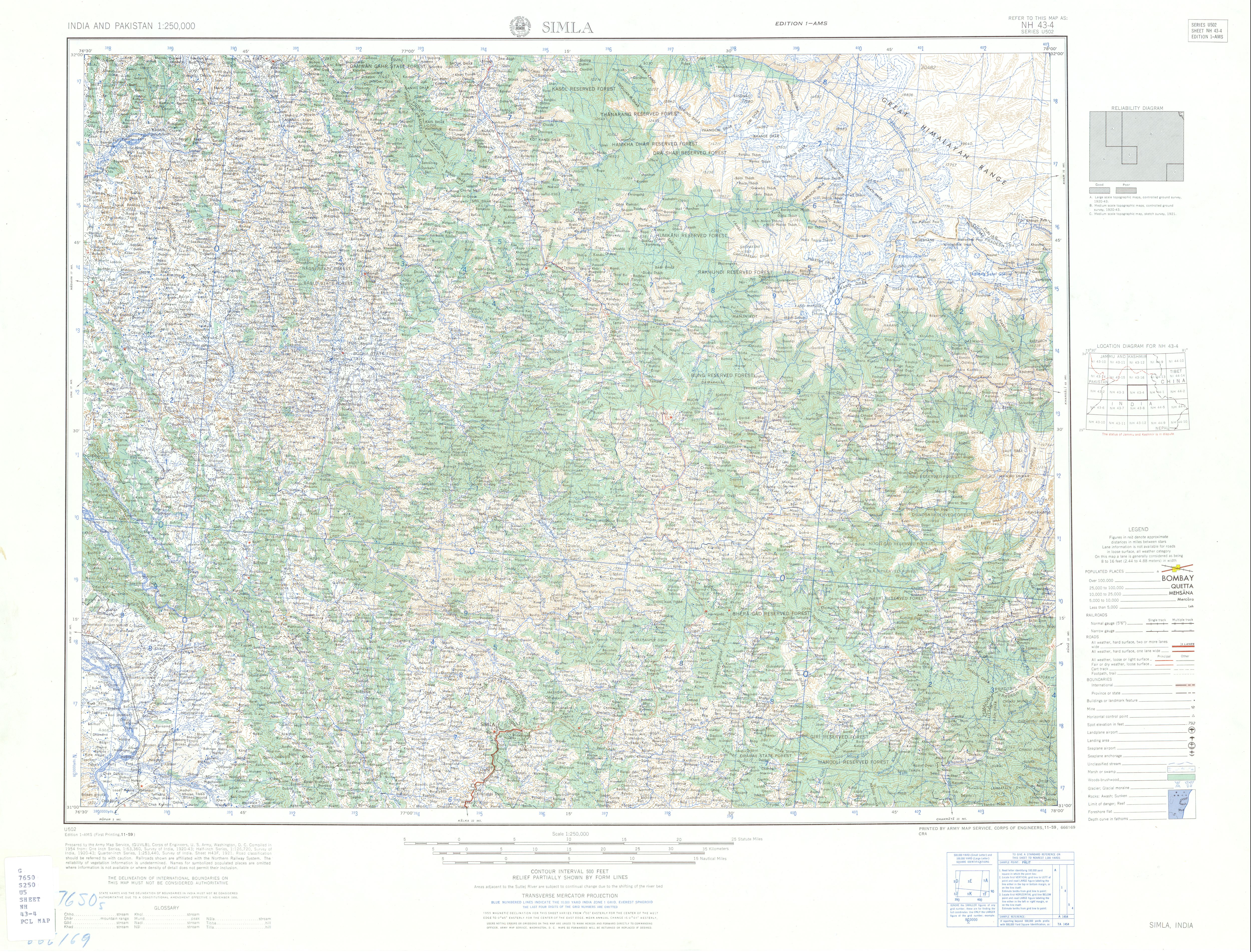
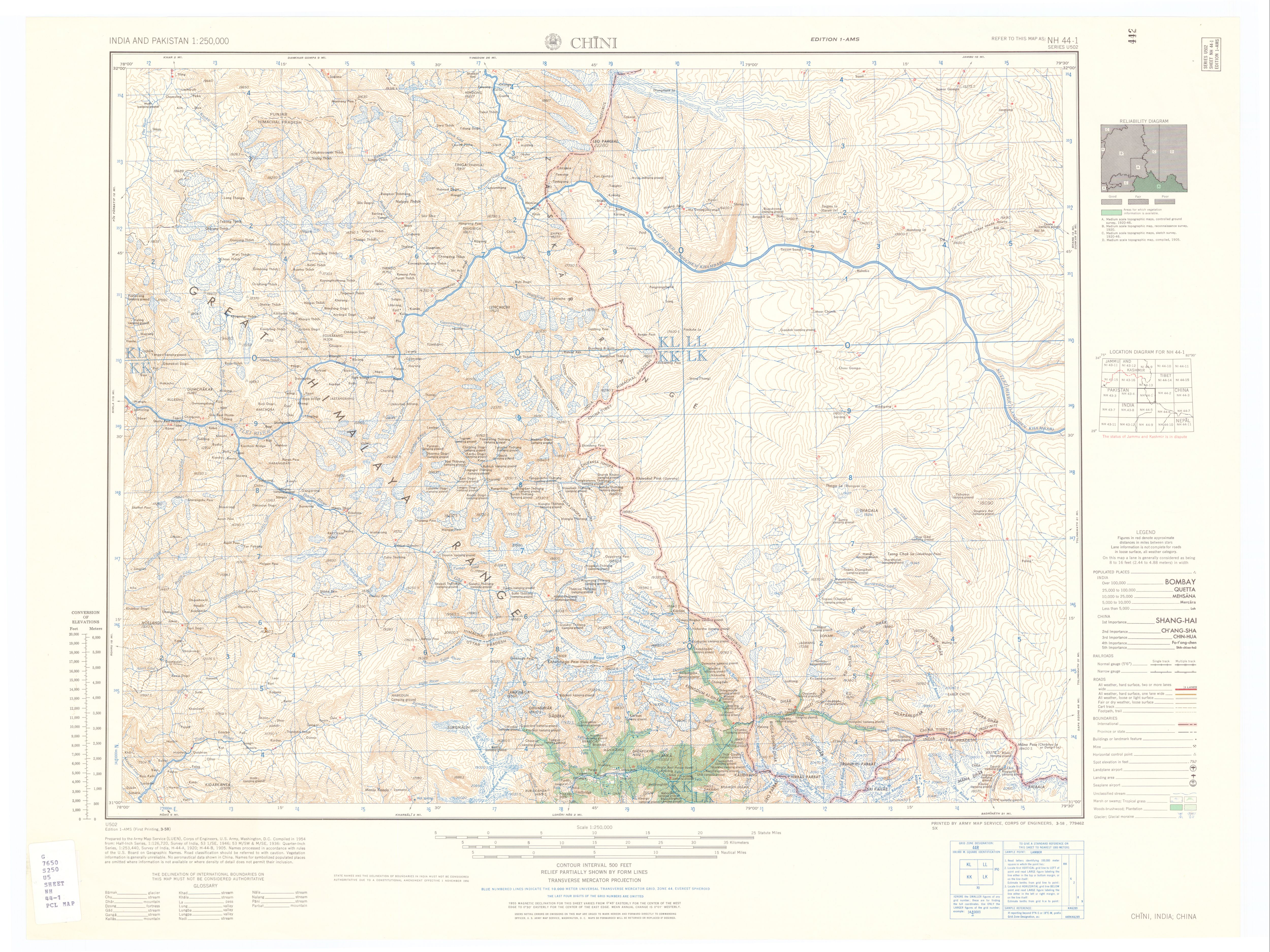
These amazingly detailed topographical maps are the legendary Series U502, made by the US Army Map Service for, yes the US Army, back in 1955. That makes them 55 years old, but boy are they out of this world. These sheets are the real thing- at least in the absence of SOI sheets. And the sheer scope of it is massive too, covering the entire subcontinent, including India, Pakistan, East Pakistan- ah the period piece ring of that- and Ceylon.

From what little of this vast map I’ve seen, most of the Himalayan regions seem to be pretty accurately mapped, at least after checking them against the others. And I can’t begin to describe the joys of learning the names of the many unforgettable places that I’ve seen in the mountains, and all that I’m yet to see. Entire ridge systems, rivers, towns have their names. Now these names might have gone out of use since all those years ago, but many of these I’ve managed to verify. The trend seems to be that of pretty accurate nomenclature.

Pic: The Dehradun Sheet of the AMS Series U502 (Bibek Bhattacharya)

The maps trip up in some places. For example, in the 'Simla' (sic) sheet, there’s a blank spot beyond the Pin Parvati pass where Spiti should be. It could be that the region had not been surveyed at the time. Then there are problems with the deeply contentious Indo-Chinese international border north of Gangotri. According to these maps, the entire Mana Gad (Gad is Garhwali for river) valley and its tributaries belong to China, although a glance through Kapadia’s Across Peaks and Passes in Garhwal gives us the real picture. At the end of the day there is no substitute for actually visiting these places.


Pic: Compare the section of the Chini sheet with Kapadia's map for the Mana Gad area in upper Central Garhwal. (Bibek Bhattacharya)

However, it must be said that where unsure, the Series U502 mentions it. They even have a handy 'Reliability Diagram' to the right of the map, where they rate the available information in that particular sheet from 'Good' to 'Fair' to 'Poor', and even list out the dates when the ground was surveyed. The oldest survey on the 'Chini' sheet, for example, are Medium Scale Topographical Maps from 1905!

Anyway, I’m completely in love. Oh, and finally, to end where I began, I now know the names of the eminences you see when you stand atop Chandrashila on a clear October day. It might be a meager victory, but to me that’s momentous!

And so, my map woes are at an end- at least until I renew the saga of SOI Topographical maps.


IndiBlogger - The Indian Blogger Community

Map Woes Part 3

(...continued from Map Woes Part 2)

So anyway, I went to McLeodganj shortly after that year, and in a small bookshop near the Dalai Lama’s monastery, I found two sheets of the Leomann Map series, these ones dealing with two of Himachal Pradesh’s regions. I was dumbstruck by their detail. There were clear ridge-lines and marked glaciers, all possible landmarks and trails, as well as most of the peaks en route. Leomann maps are, so far, the most comprehensive all-in-one set of maps of the Himalaya that I’ve come across.

Pic: Leomann Maps Sheet 4 (Bibek Bhattacharya)

After such knowledge, what forgiveness?

However, in the year and half since then, I’ve scoured bookshops and chat groups wherever I can and haven’t come across any other Leomann map. To get the full set, the only recourse to order the lot online, which I can't afford, especially with the shipping costs.

Over the past year, I’d amassed quite a few books on trekking trails, which included two quite good ones- Trekking Guide to the Western Himalaya by Depi Chaudhry and the legendary Harish Kapadia’s Trekking and Climbing in the Indian Himalaya. Both have excellent maps, although Kapadia’s book shades it, purely because he’s been all over the place and knows the terrain like the back of his hand.

This year I discovered Flipkart, and thanks to their wonderfully no-nonsense attitude to online book shopping, I was soon drowning in mountain books- and maps. The combined heft of Kapadia’s Across Peaks and Passes Garhwal Himalaya, Kumaon Himalaya and High Himalaya Unknown Valleys added some remarkable maps to my collection. Sadly, his books are horribly edited, but even bad editing can’t dampen Kapadia’s enthusiasm for the range, nor negate the sheer amount of distance that he has covered in his forty years of mountaineering. His maps are among the best I’ve seen so far. They tell you everything you need to know, and there are never any gaps in the information. They have detailed ridge lines, rivers, prominent landmarks, watershed ridges and are almost exhaustive in naming peaks in the regions.

Pic: Harish Kapadia's remarkably detailed maps (Bibek Bhattacharya)

As an aside, anyone interested to get their hands on some good writing on the range should get a hold of Bill Aitken's The Nanda Devi Affair and Footloose in the Himalaya. Both are, again, the victims of horrid editing, but Aitken's a particularly fine writer, and his passion for the range, coupled with his acute observations and charming eccentricity, make both books a must read.

Thanks to Kapadia's exhaustive maps, here was something that I could use in tandem with Google Earth to get a visual sense of the terrain in every Himalayan region. The joys were many, from charting out all possible peaks in central Garhwal- and thus solving the many mysteries of the view from Tunganath- to tracing out the more challenging trekking routes, like that from Chitkul in the Baspa valley over the Himalayan divide between Himachal and Garhwal over the glaciated Lamkhaga Pass to Harsil near Gangotri.

But proper contour maps still eluded me.

(to be concluded)

IndiBlogger - The Indian Blogger Community

Monday, 17 May 2010

Map Woes Part 2

(...continued from Map Woes Part 1)

So I looked for other maps. Some of these I found in books, and the information I tried to locate with the help of GE as well as Wikimapia (which is better marked but not always trustworthy). It’s a painstakingly slow process, but at least I was making progress.

The Eric Shipton Anthology possessed his superlative book Nanda Devi, which had a reasonably good map (which was great to get my bearings) of the Nanda Devi-Bhyundar- Joshimath-Badrinath-Madhmaheshwar area; basically central Garhwal.

Pic: Central Garhwal Himalaya from Shipton's Nanda Devi (Bibek Bhattacharya)

An infinitely better plotted set of maps soon emerged out of mountaineer and photographer Kekoo Naoroji’s book of photo essays Himalayan Vignettes. It also had a very good set of maps of Western Sikkim, the area around Kanchenjungha and Nepal Gap glacier. What’s more, the book also included sizable chunks of lower Garhwal.

Pic: A plate from Kekoo Naoroji's Himalayan Vignettes (Bibek Bhattacharya)

A third resource was Frank Smythe’s book Valley of Flowers. That book has some nice trail maps, especially of the classic Garhwal “approach trek” from Gwaldam to Joshimath via Kuari Pass and of his explorations around the Bhyundar Valley.

Pic: Map of the Bhyunder-Kamet region in Central Garhwal from Smythe's Valley of Flowers (Bibek Bhattacharya)

The problem with this was age. It was written in 1938- he made the journey in 1937- and that area was only in the process of being properly surveyed, so names of lesser peaks, glaciers and villages wasn’t exactly fixed. But it felt great to compare maps and accounts of these early writers- for a profoundly Indian point of view of the Uttarakhand Himalaya in that era, see Umaprasad Mukherjee's travelogues.

Pic: Map of the Gangotri Glacier region from Umaprasad Mukherjee's travelogue (Bibek Bhattacharya)

Needless to say, I was devouring all this.

But I longed to get my hands on some serious maps of the Western Himalaya. Being quite hidebound as well as anal in my pursuits, I especially looked out for maps of Uttarakhand, as this was the region I wanted to explore first.

(to be continued)

Saturday, 15 May 2010

Map Woes Part 1

Trying to find good trekking and topographical maps in India is somewhat like the proverbial head meeting the proverbial wall. My year of looking for the perfect set of maps- primarily of the Indian Himalaya, but also of other places- has yielded very interesting results.

I love travelogues, especially those dealing with mountains, specifically the Himalaya. Now due to the range's monumental hold on generations of visitors, there’s no short supply of great books or essays on this subject. But for an obsessive like me, what’s the fun in reading about these grand places without a good map to locate them on?

The most commonly available maps of Uttarakhand and Himachal are the Nest and Wings maps, which are a combination of various sources, including the Survey of India trekking and topographical maps, and others. Now, these are generally quite good, with towns, cities, villages, passes, roads, lakes, trails etc mentioned in impressive detail. For the longest time, they were enough for my needs.

Pic: A section of the Nest&Wings map of Uttarakhand

But with a deepening interest came the urge to collect better maps, which would chart out valley systems, topographical features, ridge lines, peaks and approaches better. Now, this isn’t an unfair thing to expect. Look up any mountainous region in the world where travelers are wont to venture, and you’ll find some excellent trekking maps- not the meagre ones that our government issues, but more on that later.

My search began in earnest last summer, after a visit to Tunganath and Chandrashila in the high Garhwal Himalaya, a place with views that make you want to sink to your knees and weep with rapture. Faced with the dramatic panorama of the Himalayan crest on the northern horizon, and the lower hills and then the plains far away, I was burning to lend nomenclature to all that I was seeing. Thanks to Nest and Wings, I had a general idea of the regions I was looking at- e.g. I could trace roughly the line from Bedni bugiyal via the high distant ridge of Kuari Pass in the west and below it, the deep cleft of the Alaknanda gorge. Where mid-day clouds covered the horizon, I expected the western arm of the Great Himalaya, containing the likes of Trishul, Nanda Devi, Dunagiri, Hathi Parbat, Ghori Parbat and Kamet, to name a few.

Pic: Nanda Devi looking west from Chandrashila (Bibek Bhattacharya)

In front of me, just beyond the end of the ridge running north from where I was, the cairn strewn summit of Chandrashila, loomed Chaukhamba. It is also known as Badrinath, after the Dham, and these four pillars of snow, ice and granite held sway over the imagination of Garhwal.

Pic: Chaukhamba looking north from Chandrashila (Bibek Bhattacharya)

On its northern face it formed a cirque of peaks at whose feet arose the Gangotri glacier. Further north west ran the line of the southern faces of a host of well known peaks that cluster around the Gangotri Glacier.

It was impossible, however, to be sure of the names of the peaks- apart from those of Kedarnath and Chaukhamba- at least for me. Having recently discovered Google Earth, however, I was hopeful of finding out the names.

Pic: An overhead screenshot of Uttarakhand Himalaya

Google Earth was quite brilliant, visualizing the peaks for me, but they weren’t named, at least the vast majority weren’t. In this case, Nest and Wings was useless.

(to be continued)

IndiBlogger - The Indian Blogger Community

Friday, 9 October 2009

Chandrashila

I sat beside a cairn atop Chandrashila watching clouds rise. Freezing in Sujaan's choti at Tunganath, a combination of sleep deprivation and oxygen depletion had effectively ruled out my much cherished ambition of making it to the peak before sunrise that day. Feeling a little better as the day wore on, I decided to make a try for it. After all, it was a beautiful sunny day.
At Tunganath, the weather changes every ten minutes. This a local saying, and absolutely true. I definitely didn't want to tempt the weather while the sun was still shining. So I told Biru to wait a bit for Sujoy and Debo- the friends I was travelling with- to wake up and struck off on my own. I had last climbed it in May this year. I was way fitter then, so I had very little hopes of making it up there without huffing and puffing my lungs out. As it turned out, the mountain paid me a huge compliment. Probably because I was a lot better used to breathing on this altitude, even with stops to make calls to people (high up the peak I was getting a signal from Gopeshwar on the other side of Chandrashila!) and admire the scenery, I still managed to get up there in half an hour. I was about to ring the bell at the tiny temple of the moon, when I happened to look beyond, and time literally stood still. Far away, yet strangely near, on the North Eastern horizon rose a gaggle of sharp peaks.

Pic: Nanda Devi and her sisters hold court on the far horizon
Two I could immediately recognise because of their distinctive shapes- the mighty Nanda Devi, and Hathi Parbat, the presiding peak of the Bhyundar Valley.
The temple was forgotten. Mindful of the fact that soon either my camera's going to freeze or that the batteries are going to give up, I quickly took as many snaps of this magnificent scene as I could. In the not-quite-noonday sun, the distant white peaks look like translucent chalk sketches against a blue 3D sky. Needless to say, it was unlike anything I'd ever seen before, except maybe in some dream.
The immediate patch of rocky ground behind the temple (the highest point on the peak) is covered with cairns. These vertical structures of various sizes are made from slabs of stoes from the peak and seem to be constantly made and re-made. In May I had asked Biru what these structures signify and he'd said that these were memorial stones. To my fevered imagination they look more like portals into some other world. Amongst them, a Japanese man was singing.
It was a surreal sight. This middle aged man had planted his walking stick upright, slung his thick ski jacket and hat over it, and was lying in its shade reading a book, and occasionally breaking out into song. He grinned at me and went back to reading and singing.

Pic: A Japanese sun-worshipper on Chandrashila

A few feet from him, at another part of the peak behind some other cairns, another of his compatriots was sitting still in a lotus position with his face towards Nanda Devi, deep in meditation. In all there were three of them. I was to bump into them over the next few days, either meditating on tatami mats on the peak, or wandering about wearing a lost look in Tunganath, where they were staying at a different choti.
Making sure that I wasn't disturbing them, I plonked myself down on a rock face overlooking a deep precipice. Down below, through the haze and rising wisps of clouds I could see the wooded valley that had so caught my fancy the last time I was here. In front of me, still visible clearly, rose the distant panorama.
It felt just so exhilarating to finally see Nanda Devi, unencumbered, in all her glory. The other time I'd seen her, it wasn't this sideways view. Rather I'd seen her head on, part veiled by the Mai ki Toli ridge, but with both her twin peaks visible. This was from the Binsar sanctuary in the Almora hills of Kumaon, from where its much closer. From the peak though, she looked serene, detached from the dramatic, wild beauty of her environs. Its easy to see why people revere her so.
But my view of her and the other distant giants depended purely on the whim of the clouds. By nine thirty, the day's heat had had its effect on the sub-tropical climate in the valleys which were giving rise to a succession of little pillow like clouds. While many dissolved in the cooler air above, many more started to form little gangs, which then became bigger gangs.

Pic: Cloud-eye view

Clouds change shape better than any con artist. Constantly forming, disintegrating, reforming, flowing into, out of, over and around ridges, they form an elaborately graceful ballet of carefully choreographed chaos. And so they roamed about me, avoiding this high peak, but erecting and dismantling teasing curtains between me and the distant peaks. So every now and then, all evidence of the far vistas would vanish, leaving me to wonder at what I'd seen. The first time Nanda Devi was cloaked, two Monal took wing, circling overhead while uttering mournful cries, as if in her memory. Then there were the giant Himalayan Gryphons, their backs glinting in the sun, gliding from one air current to another, circling the upper air. They seem totally at home, yet impervious to the beauty of the place.

Pic: Massive Himalayan Gryphon flying high

As the sun climbed higher, the ever present buzzing of large , laggardly flies increased. I'm absolutely not well informed on insects, but the sheer variety I saw on this lonely peak was breathtaking. And then there were ravens. Massive black birds, graver and more ominous than your average crow. They seemed to be constantly watching, flying from one impossible rock overhang to another, squawking, and making these strange half conversational sounds. They are mysterious birds, who indeed hold parliaments when there is a quorum. I can't think of a more appropriate word to describe a group of these birds.
When there was nothing to see, I simply closed my eyes. Immediately my ears pricked up. The wind blowing; a sensation of cool moisture on my cheeks; rustling, buzzing insects; an occasional avian cry. But above all, silence. Every now and then, a sound from a distant village, many thousands of feet below. Startling and funny, like rocks talking to each other.
After a spell, I opened my eyes, and the clouds had shifted. I could see Nanda Devi and her sisters holding court again in the bright sunshine. To my right, above the great green valley that leads to the Anusuya Devi temple in the jungle, huge plumes of clouds were forming. In front of me, due north, Neelkanth was suddenly revealed in all her glory. Further North East small tufts of clouds hung in the air between Chandrashila and the Kedar Massif, casting little shadows on the rich bugyals (high altitude meadows) below the range. At moments like these, I stared in vain at my notebook, struggling to find words evocative enough to describe this beauty. I smiled to myself, imagining the poet Coleridge on this peak, startled out of his opium haze into a fresh appreciation of the sublime. He was a staunch lover of mountains, sometimes recklessly so. One one occasion, he managed to get himself trapped in an impassable grotto in the Lake District. With dusk coming on, and risking exposure, he decided to shut his eyes, take a deep breath and will his way out of there. Opening them, he realised that there indeed was a way- through a difficult and dangerous rock scramble. Sure enough he did. A fascinating story. My guess is, he'd have loved this place.
Bang in front of me, between Chandrashila and Neelkanth, rose a bleak naked rocky ridge, which the local people refer to as kala paththar. An evocative enough name. Back in May, it was covered in snow and ice, but now there were just rocks, and the occasional huge gash signifying the path of a winter snow-field. But it says something about the enormity of the geography here that these same locals believe that there's nothing there. Wrong. Behind and beyond that ridge lies Nandi Kund, an enormous lake from which rises the Madhyamaheshwar Ganga, as well as the huge green hanging valley of Pandosera. That way lies a high track that crosses a couple of high passes under the toe of mighty Chaukhamba to gain access to the Bansi Narayan temple on a massive ridge further to the East overlooking the Alakananda Valley. According to Biru, many sheep-herders often go that way, as do other local people to collect Bramhakamals or the huge lotuses that the high Himalayas are famous for. Someday I'll get to see the place, I hope.

Pic: The forested river valley below Chandrashila, with a snow covered Kala Paththar in the background.

Chandrashila is the highest peak on a long, high and incredibly serrated ridge that runs south to north from the forested valley of Chopta to the highlands below Chaukhamba, running parallel to the Sari and Madhyamaheshwar ridges. Some of the other high ridge-points that I'd been climbing over the last few days with Biru now lay below me- awesome mountains in their own right, but somehow dwarfed by their magnificent setting. As I gazed, some ravens took wing, circling lazily in the morning haze.
Through all the shifting weather, the four white pillars of Chaukhamba rose imperiously, as if above human concerns, glinting severely yet reassuring in the sun. To think that just behind its massive ramparts lay the Gangotri glacier and all those fabled peaks.

Pic: Chaukhamba

Some of them I could see from there- Thalay Sagar and Shivling, beautiful spires both, are visible slightly behind the Kedar Massif. Then come the peaks of Meru, Mandani, the Bhagirathi group. Many peaks, of which I am not sure of the names. In those fabled lands had travelled both my heroes- Eric Shipton and Umaprasad Mukherjee. Both had also come here. In his journal on the 1934 Nanda Devi expedition and the subsequest crossing of the Kedar-Badri watershed under Chaukhamba, Shipton wrote about a zig-zag high altitude pass he took to get to Chamoli back on the way to Joshimath on the road to Badrinath. There it is below me, rushing down the eastern face of Chandrashila on its way down to the forests of Mandal to join the motorable road to Gopeshwar and Chamoli.

Pic: The old pilgrim trail

Mukherjee made special mention of this pass, extolling its natural beauty and bemoaning the unwillingness of pilgrims to take this harder but more enjoyable old route just because there was a tarmac road passing below through Chopta. He was writing in the early 60s. Now, it has fallen even more into disuse. While in the dry cold weather of May, I could easily make out the contours of the path, now in verdant October, just a memory of the path existed. Mukherjee was a deeply religious man, but even he acknowledged that the true reward of making the long and arduous climb to Chandrashila was this view of the high peaks. Amen.
This land is so old. It fills you with a deep awe that's beyond simple religiosity. As I sat in that private paradise of mine, I prayed that I'd never forget it.

IndiBlogger - The Indian Blogger Community

Thursday, 8 October 2009

Good Day Sunshine!

Jumping out of bed at the cold, unearthly hour of 4:30 am I stepped out in the freezing night to have my breath taken away by the galactic arm of the Milky Way stretching over me. But I hadn't much time to lose, as I had to get to the peak of Chandrashila by 6 am or miss the fabled sunrise. So I ran in the lightening darkness, my lungs heaving with the effort in the rarefied air and my head spinning with the cold and the exertion. Behind me the Chaukhamba and Kedar peaks brightened in the fast-approaching dawn. Ahead of me, on the ridge-line the silhouettes of other sunrise-spotters intent on their goal, trudging up. One by one I overtook them, my head spinning. Below and behind, I could see a torchlight in the darkness- Debo and Biru coming up behind me.
A loud yell of exhilaration escaped my throat as I rounded the last hump and came up in front of the temple of the moon atop Chandrashila. The sky had cleared behind me, though Chaukhamba and the other giants had yet to catch fire. I made my way through the gaggle of people on the peak to the farthest point on the ridge. This is what I saw, over a half hour that lasted forever. Night below me and daybreak at 4,100 m. The sun came out slowly, like a grand comedian with impeccable timing, behind the beautiful spire of Nanda Devi.


IndiBlogger - The Indian Blogger Community