Rain fell in violent gusts all night. It had become quite cold. I was more or less comfortable in my foam sleeping bag, but Oli was shivering in her flimsy sack, and KP was positively suffering. He'd caught a cold and the previous day's sudden gain in altitude had not helped either. I gave him some analgesics to help ease his headache. At some point we managed to get some sleep.

The day dawned with the weather in an even worse state. Everything was dank and gloomy and heavy rain was falling in a continuous sheet of loud grey. Outside, Triund was a sight of thick clouds being tossed about the ridge. Clearly there was no hope of making an early start for Laka. Gulab and Jagdish were already up and we were greeted with lovely cups of tea. While the others got up, I lazed around in my sleeping bag and dozed for a while before making my way to the kitchen. All our wet stuff was still wet so that was another thing to get used to. Jagdish's prognosis of the weather was not too good. He was skeptical of the rain stopping anytime soon and figured that the main nala that we'd have to cross between Laka and Lahesh would be in spate even if the weather did break later in the day.
We felt quite gloomy at this turn of events. Suppose we had to call off the trek? I couldn't bear thinking of that possibility, but we couldn't wait indefinitely at Triund either, waiting for the weather to turn and eating our way through our supplies.
It was pointless to sit around in the hut and mope. After a few biris smoked in companionable silence, Jagdish and Gulab wandered off to chat with other paharis. KP wandered off to get wet. He had gotten over the night's unease and that old familiar serenity had returned to his face. Oli was driven to distraction by his behaviour, but it seemed like a perfectly normal thing for him to do.
Every now and then the rain would slacken and I'd step out in the sloshy grass to take a few pictures of stormy Triund. And it was beautiful. Above us, nothing could be seen save the ghostly outlines of the Laka ridge, across which gossamer thin strips of cloud were being hurled by a strong East wind. The forest hut itself was protected from this onslaught by the main ridge of Triund. I climbed up this and was immediately buffeted by the wind as I struggled to keep my ears warm and camera working.

The Dhauladhar for all intents and purposes might not even have existed, so thick was that impenetrable curtain of clouds strung across its face. It occurred to me that since a brief glimpse of the Mon early the previous morning when we were rolling in to Dharamshala, I hadn't had a single view of the range. It was dispiriting, but my surroundings didn't allow me to dwell on this for too long,
Unless you go looking for it, its difficult to come across such an elemental scene of wild beauty. Facing the Laka ridge, to my west lay the steep path we had climbed to Triund. Far below, around the edge of a spur seemingly poised on the brink of a great plunge into the tangled construction of McLeodganj, hung the tiny Magic View Cafe. It kept wavering in and out of view as banks of clouds swallowed it up momentarily, and then, driven on by the wind, moved on leaving it visible again. High above that spur ran the wall-like broken ridge-top of Laka, dotted with weirdly contorted rhododendron and pine trees amidst extensive boulder gardens. To the east lay the thickly wooded valley of the Chauran nala, some 2,000 feet below, flowing down from under the south face of Mon. Looking down the mountainside into that mysterious shifting landscape of deep mist and thick vegetation and the occasional massive rocky outcrop was a thrill in itself.

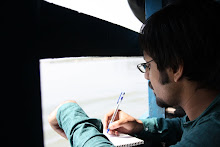
However it was impossible to stand for too long in that driving rain and I ducked back down under the protective curtain of the ridge-top. It was afternoon now, and though the light had improved, the weather remained as bad as ever. Oli, the eternal pragmatist, was well into her carefully rehearsed acclimatisation routine. After a hearty breakfast, she had settled down to write. I had tried keeping a journal as well, but I tired after one page, and the notepad was too soggy to write in anyway.
KP had gone off in the rain to meet Sunil, and the great, wet shaggy dog who'd been a refugee at our doorway had also tired of the inactivity and had wandered off. Leaving Oli to her writing, I went to look for KP. Little mirrors to the sky had formed on the path along the ridge and I made my way through the wet grass to Sunil's shack. KP was sitting outside the shop, rolling. The interior of the shop was occupied by an excitable gaggle of English voices discussing ephemera, so I stood outside under the flapping tarpaulin, watching the capricious clouds play on the ridge above. One of Sunil's many (apparently) ponies wandered by, dutifully grazing. Scattered groups of cows ate their way up and down the grassy slopes, resembling for all the world massive, mobile vacuum cleaners.
I stood there spacing for what seemed like a very long time. I was feeling very lethargic for some reason, so I made my way back to the hut, only to find Oli in the second stage of her steady acclimatisation process- she was lying in her sleeping bag and trying to feel warm, while reading a book on rock climbing, and trying out different knots with a wee length of rope. It felt pretty funny, hanging out with these two mountain lovers with their radically different approach to life on the heights.
Me, I'm the worrying kind, and I'd been worrying a fair bit since we'd started the day before. And one of my main worries was this matter of acclimatisation.Thanks to my two visits to Tunganath last year, I had successfully breached the 4000 m barrier, but then that was nowhere near as physically taxing as this would be. Although I'd only mildly felt the effects of altitude back then, I wanted to be absolutely sure this time around. Also, KP just had to acclimatise, as he'd never been anywhere higher than Laka, which is approximately 3,200 m. So when Oli instructed me to lie down and take a nap, I obediently crept into my sleeping bag. As I drifted off to sleep, I heard KP calling Oli out. Apparently it had stopped raining.
As soon as I'd fallen asleep, it seemed, I was rudely awakened. It was Oli of course, in that cheerfully steely voice of hers, instructing me to get up and come for a walk. It turned out that I'd been soundly asleep for a good 45 minutes or so. In that time, the weather had cleared somewhat. Most importantly, it wasn't raining. Outside, it was quite gorgeous. The Dhauladhar was still hidden. However, the overhanging cloak of clouds had receded a fair bit and was now draped over the head of the range. The snow fields, mini glaciers and the ice colouirs that can be seen pretty much all the year round had melted into forceful waterfalls and streams. Just the sheer number of waterfalls coming down from the all-pervading cloud was quite mind-boggling.
The cloud canopy stretched out from its tether on the Dhauladhar all the way to the distant Punjab plains, shimmering blue in the afternoon. Sandwiching us from below was a vast sea of blue clouds, filling up the entirety of the Kangra valley.

Oli suggested that we climb some way in the direction of Laka, and so we did, picking our way up the steep trail, trying our best to outflank the copious shit that that the cows had been depositing all day. The weather was so fine, that the three of us seriously considered making a dash for Lahesh. Even Gulab, who'd joined us for the ramble, made some noises to that end.

Suddenly I looked up to see a grave furry face regarding us from a rocky outcrop. It was one of the Gaddi dogs- invariably called Tommy, or Johnny or Bhalu. We climbed up a bit higher till the point where the Triund spur united with its parent ridge of Laka. Oli bounded off ahead. She was obviously feeling this need to keep moving, but I, as usual, stopped to take yet another view of my surroundings. Closer now to the main range, I could get a good look at the giant flanks of the Dhauladhar. The mountainside was a jumble of massive rock falls and boulder fields. The rain-fed Chauran nala was gurgling down in the forested ravine below me. To the easte, running parallel to my Triund spur, were others much like it. Each of these ultimately lead up to the various passes that punctuate the main range. What fun it would be, I thought, to wander about these spurs, traversing the breadth of the range.
In fact, I'd been seriously thinking of turning our little project into a treeline trek, going all over the Southern face of the Dhauladhar. But that route just didn't possess the joy of crossing two passes, even if it would be a worthwhile way to explore the land. But I still held some hope that the weather and Indrahar would relent.
KP and Gulab were sitting a little way below me deep in conversation, brilliantly silhouetted by the blue cloud-sea that was the Kangra valley.

Oli returned in a bit, looking as energetic as ever. Her exuberance is quite infectious, so we decided to climb up to the Tibetan prayer flags festooned at a point on top of the ridge that marks the area where the Triund spur merges with the Laka ridge. We'd gone a little way when we saw two figures bounding down the Laka track. They were an American hiker and his Gaddi guide. A shouted conversation with the guide ensued. They were returning from Lahesh and according to him, the trail was perfectly safe as of now. The nala that had so haunted our plans was in spate, but was crossable. According to him, we could still try for Lahesh.
This further added to Oli's restlessness and she rushed down to Triund to discuss this with Jagdish. He'd been full of doom the entire day, not trusting the weather- or was it our capability? Anyway, since it was getting on to 4 pm, and we weren't exactly travelling light, I thought it would be better to spend another night here and start tomorrow morning despite the weather.
It was a lovely afternoon to be at Triund, so me and KP sat around, chatted in fits and starts and took some pictures. Then we started down at an easy pace, while KP filled me in on Sunil's fifty horses and the envy this caused among the other paharis. A couple of years ago, when KP had first come to McLeodganj, some of his Gaddi friends had brought him up to Triund in a direct line that climbed the 3,000 feet from Bhagsu along the entire length of the Triund spur. Ridiculously steep in places, it had both enchanted and scared the living daylights out of KP. We decided to check it out.
We met Oli as she was coming up to us. She'd managed to get Jagdish to promise that we'd make an attempt to get to Lahesh the next morning. She seemed a lot calmer as a result. That particular load off our heads, we truly enjoyed ourselves for the next couple of hours, walking around on the beautiful rain soaked green turf of Triund while the world below us seemed to be drowning in an ocean of blue. Oli got me to climb some rocks too, and despite misgivings, I did fine, aided a good deal by my veteran boots which, after some eleven years of rough use, still retained a fantastic grip. KP, extremely disinterested in all this exertion, took to impersonating a human rocky outcrop. Every now and then I would see him standing on some rock, dramatically framed by the seething blue clouds, quietly contemplating the void.

The wind was picking up, gently blowing tendrils of clouds from the layer below us to the one above. We sat in perfect silence, each of us lost in our own thoughts.
Before our eyes, the Mon began to do a striptease. At first only a ghostly outline, the high winds near its summit slowly blew away the clouds obscuring it from view. Presently the peak and a large portion of the summit ridge slowly revealed itself in all its stark, brooding glory.
Owing to the time of year, the snow-less Dhauladhar resembled a fortress made of tiers and tiers of black rock. Not for the last time, the scene reminded me of something out of Lord of the Rings. Indrahar was a tiny notch to the left of the peak, one that you'd easily miss if you weren't looking for it.

From here the south face looked so sheer and perpendicular that the thought of actually being on it made me involuntarily shiver a bit. With the weather we were having, this looked like serious business. But instead of being freaked out, I felt a desperate urge to be on top of the damn thing. If I could've started out right then, I would have.
Meanwhile, Triund was having a regular day. After the day's 'Garbage In Garbage Out' the cows had retired. There was one standing motionless while a tourist filmed it. Young Johnson, a sweet Gaddi dog who'd been accompanying us all afternoon was trying to turf out the cow by barking furiously. The tea shops were buzzing with talk, laughter and endless cups of tea. Now that the day trippers had returned to McLeodganj, there was a fair degree of fellow feeling among those who'd stayed back.

It was getting cold and windy, so we went back to our little hut. I was getting pretty fond of this little place, it felt like home. Gulab got some tea going while KP and Oli pottered about doing nothing in particular. I sat on a rock next to a blasted tree and spaced, looking out to the far distance where the massively swollen Pong reservoir was glittering blue. Then the thick clouds covering Kangra slowly started climbing up, ominously obliterating everything in their path. Spooky. Another evening of desultory conversation, dinner and early to bed. We would make an attempt to get to Lahesh cave the next day.
To be continued...